

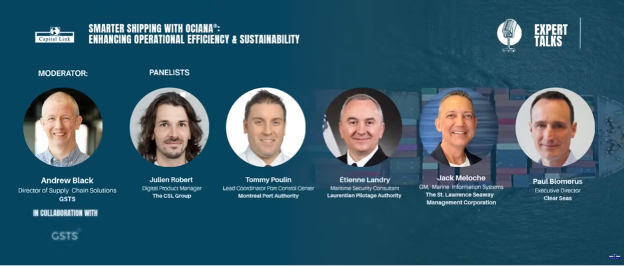
The maritime industry is entering a new era—one driven by data, AI and collaboration. During a recent Capital Link webinar, “Smarter Shipping with OCIANA: Enhancing Operational Efficiency and Sustainability,” experts from across Canada’s marine supply chain came together to discuss how innovation in port technology can unlock smarter, greener, and more coordinated shipping.
Panel participants included:
- Andrew Black, Director of Supply Chain Solutions at GSTS (moderator)
- Julien Robert, The CSL Group (Canada Steamship Lines)
- Tommy Poulin, Montréal Port Authority
- Étienne Landry, Laurentian Pilotage Authority
- Jack Meloche, St. Lawrence Seaway Management Corporation
- Paul Blomerus, Clear Seas Centre for Responsible Marine Shipping
Together, they tackled pressing port technology questions about the future of shipping. In this blog, we’ll unpack a few key takeaways from that discussion.
Supply-Chain Value
Andrew Black, GSTS: What supply-chain value is created through streamlining the ship-to-shore interface, and who benefits?
Julien Robert, The CSL Group: Everyone in the maritime supply chain benefits from a smoother ship-to-shore interface, though the advantages vary by stakeholder. For ship operators, greater coordination results in faster turnaround times, enabling vessels to carry more cargo within the same operating window.
It also allows ships to reduce speed in transit when port services aren’t yet ready—saving fuel, cutting emissions, and avoiding unnecessary time at anchor. In some cases, ships can even reduce costs for pilots, tugs, or anchorage fees, since better planning eliminates redundant service calls.
For ports and terminals, improved synchronization helps reduce congestion and simplify scheduling, resulting in smoother berthing processes and more efficient use of limited infrastructure. Pilots, tug operators, and terminal crews also gain from more predictable scheduling, fewer last-minute changes, and more efficient deployment of their resources.
Finally, cargo owners and shippers benefit from lower transportation costs and more reliable delivery schedules. By reducing delays, inefficiencies, and idle time, the entire logistics chain becomes more predictable and cost-effective.
The overall outcome is a shared win for all participants: fewer inefficiencies, lower costs, and a more sustainable and transparent supply chain.
AI and Collaboration
Andrew Black, GSTS: In the age of AI, why is collaboration so important to enabling just-in-time arrivals and port-call optimization?
Julien Robert, The CSL Group: While AI can help identify effective operational solutions, the maritime sector still relies heavily on non-digital communication — such as radio calls, phone conversations, and manual coordination. Because of this, AI alone can’t function effectively without collaboration between the many human and organizational players involved. This joint vetting process ensures that every AI-generated plan is practical, safe, and mutually agreed upon before execution.
Tommy Poulin, Montréal Port Authority: AI is only as effective as the data it receives. For example, sometimes a ship might broadcast its destination as Hamilton but plans to stop in Montreal for inspections or refuelling. Without real-time data sharing among partners, AI could make inaccurate predictions. This shows why collaboration ensures that everyone operates from the same live information, rather than outdated snapshots.
Jack Meloche, St. Lawrence Seaway Management Corporation: Within the Seaway system—comprising a series of locks and connected waterways—AI tools help plan vessel traffic and resource allocation. However, these benefits depend on shared data between all stakeholders (pilots, ports, and carriers). Collaboration ensures the system operates efficiently and safely across multiple jurisdictions.
Étienne Landry, Laurentian Pilotage Authority: Collaboration is key to maintaining strong, trust-based relationships between maritime entities. The Laurentian Pilotage Authority’s mandate to ensure safe and efficient pilotage depends on close coordination with ports, carriers, and regulators. Collaborative data sharing enhances operational awareness and strengthens the synergies needed to adapt to evolving technology and real-world conditions.
Paul Blomerus, Clear Seas: Collaboration enables operational efficiency and enhances the industry’s credibility in the eyes of coastal and Indigenous communities. By sharing high-quality, vetted data openly, maritime organizations can build public confidence and demonstrate responsible, sustainable practices.
Port-Call Optimization
Andrew Black, GSTS: What are the benefits realized by the port and its partners through port-call optimization?
Tommy Poulin, Montréal Port Authority: Port-call optimization provides tangible, practical advantages for both the port and its partners. Optimization helps reduce delays and accelerate vessel transit, ensuring that ships, berths, and services are all aligned in terms of timing. This allows vessels to spend less time waiting and more time moving, directly improving efficiency.
There are also environmental benefits. Just-in-time arrivals enable ships to adjust their speed, resulting in lower fuel consumption and reduced greenhouse gas emissions.
Port-call optimization also significantly enhances resource scheduling for pilots, tug operators, and terminal crews, allowing each to plan their shifts more effectively. Improved coordination also enhances connectivity between marine and inland logistics, supporting more effective carrier scheduling and improved overall supply chain reliability.
Common Collaboration Platform
Andrew Black, GSTS: Since each party already has its own systems (PMIS, TOS, pilot dispatch, ship systems), why do we need a common collaboration platform?
Julien Robert, The CSL Group: The real value of a common collaboration platform lies in its neutrality and inclusivity. For optimization to be effective, all stakeholders, including competitors, must participate and share data within the same environment.
It’s difficult for any one company to convince competitors to join its internal system. That’s why an independent, trusted “middleman” is necessary to bring everyone together on a shared, secure platform. Such a platform must be seen as impartial, allowing each participant to share relevant operational information without fear of commercial bias or data misuse.
Tommy Poulin, Montréal Port Authority: OCIANA was the first time I have seen a system where everyone contributes their own information into one shared space. It represents a significant step forward in transparency and coordination, as it enables all stakeholders to view the same data in real-time, rather than relying on fragmented communication between separate systems.
Étienne Landry, Laurentian Pilotage Authority: The emergence of a common collaboration platform reflects the growing technological maturity of maritime organizations. The sector is finally at a point where sharing valid, timely information strengthens efficiency and helps align safety, security, and commercial competitiveness across the maritime corridor.
Sustainability in Shipping
Andrew Black, GSTS: Do you see any challenging policy objectives for safer or more sustainable shipping that OCIANA can help solve?
Paul Blomerus, Clear Seas Centre for Responsible Marine Shipping: Canada’s shipping governance structure is quite fragmented, shared among Transport Canada, the Canadian Coast Guard, and individual port and pilotage authorities. This has made digital integration across the sector more difficult. While each organization has developed its own advanced systems, the country still lacks an integrated, national digital maritime platform.
OCIANA and its Collaborative Optimization Solution (COS) bridges that gap by providing a single point of reference for maritime data and coordination, contributing directly to important policy goals such as the implementation of a Maritime Single Window (MSW) — a global initiative encouraged by the International Maritime Organization (IMO) to streamline and unify vessel reporting and clearance processes.
Beyond policy compliance, while environmental issues like greenhouse gas reduction are vital, the public’s main concerns often revolve around safety — specifically, preventing oil spills, groundings, and other maritime accidents that can threaten coastal ecosystems and communities. By enhancing visibility, predictability, and coordination among all stakeholders, OCIANA can help mitigate operational risk and prevent such incidents.
The predictive analytics and real-time situational awareness offered by OCIANA enable authorities and industry stakeholders to act early — for example, identifying a drifting vessel or congestion risk before it becomes a safety or environmental incident. This kind of risk mitigation directly supports Canada’s policy objectives for both safer and more sustainable shipping.
OCIANA also strengthen the “social license to operate” — the public’s trust that the maritime industry is acting responsibly and transparently. By enabling consistent and transparent data sharing across organizations, OCIANA can help build confidence among coastal and Indigenous communities that shipping activities are being managed with safety, sustainability, and accountability at their core.
Port Technology to Optimize Berth Efficiencies
Andrew Black, GSTS: The maritime environment is dynamic, and a missed berth window can have cascading impacts—why is advanced awareness of what’s happening in a port important to you?
Tommy Poulin, Montréal Port Authority: During the summer’s low-water conditions in the St. Lawrence region, circumstances could change daily, affecting safe draught, transit speeds, and pilotage windows. In such a volatile environment, having advanced situational awareness is critical.
When ports, pilots, and carriers all see the same real-time operational picture, they can act early and proactively. That allows them to re-sequence port calls, update estimated times of arrival (ETAs) and berthing times (ETBs), adjust vessel speed, and reallocate resources before issues escalate.
Being proactive turns what could become a disruptive, costly delay into a manageable operational event. Advanced awareness also helps protect safety, schedules, and costs for everyone involved.
Étienne Landry, Laurentian Pilotage Authority: For the Laurentian Pilotage Authority, timely information is absolutely essential. Real-time awareness of port conditions, weather, and vessel operations allows the Authority to plan pilotage assignments more efficiently and respond quickly to changing circumstances.
During low-water conditions or similar disruptions, having forward visibility—rather than reacting after the fact—enables better decision-making and coordination among all partners. It is also critical for maintaining safe and reliable pilotage operations in a dynamic river system like the St. Lawrence.
Jack Meloche, St. Lawrence Seaway Management Corporation: A port’s missed berth opportunity is akin to missing a lockage slot in the Seaway system. When a vessel misses its turn, it can lose its pilot, be forced to wait for other ships, or even face a delay in the opposite traffic direction.
When every stakeholder shares accurate, real-time data on vessel positions and timing, the entire Seaway system becomes more efficient and predictable. Advanced awareness is what prevents one missed event from triggering a chain reaction of congestion and delay throughout the network.
Julien Robert, The CSL Group: Advanced warning and precise communication are vital because shipping is just one link in a much larger supply chain. When disruptions occur, every connected party—from rail and terminal operators to shippers—needs time to adapt.
If a vessel’s delay is communicated early, rail operators can hold or reroute cargo, terminals can adjust loading plans, and ports can reprioritize berths. However, if notice comes too late, the cargo may have already been delivered and staged, resulting in inefficiencies and additional costs.
Importance of Collaboration
The panel emphasized that collaboration is the cornerstone of resilience and efficiency in the maritime sector. The industry operates in an environment of constant uncertainty — from sudden weather shifts and congestion to events as unpredictable as pilot injuries or low-water conditions that affect safe passage. In such a dynamic system, no single stakeholder can operate in isolation.
Effective coordination among ports, pilots, carriers, terminals, and regulators enables all parties to respond swiftly to disruptions and, increasingly, to act proactively rather than reactively. Collaboration also fosters shared situational awareness, allowing stakeholders to align vessel movements, optimize berth windows, and prevent costly chain reactions across the supply chain.
When everyone operates from the same, real-time information, ships can adjust speeds to match port readiness, saving fuel, cutting emissions, and reducing idle time at anchor. This level of coordination not only safeguards safety and operational efficiency but also supports environmental sustainability and builds trust among coastal and Indigenous communities.
Contact us to discover how OCIANA’s collaboration functionality can transform potential disruptions into synchronized, data-driven decisions that strengthen the entire maritime network.

 English