
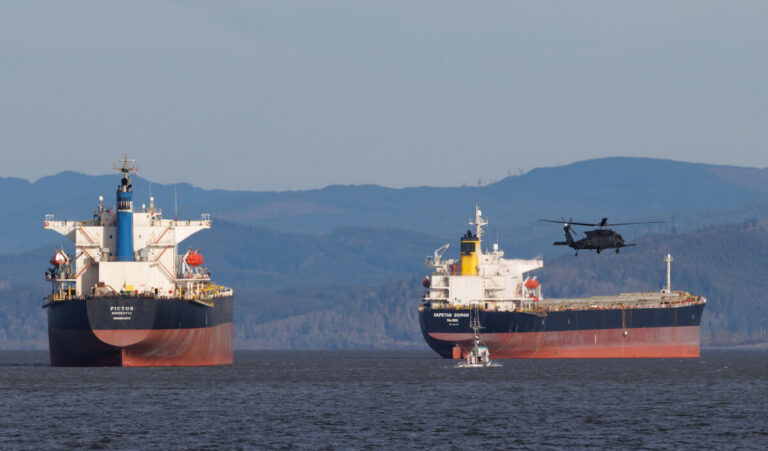
Maritime security encompasses the policies, monitoring systems, enforcement measures, and cooperative frameworks designed to protect oceans, ports, and shipping lanes from unlawful or disruptive activities. Its goal is to safeguard human lives, economic interests, and marine ecosystems while supporting stable maritime operations.
Threats addressed by maritime security include:
- Piracy and armed robbery at sea
- Smuggling of narcotics, weapons, migrants, or sanctioned goods
- Human trafficking via maritime routes
- Illegal, unreported, and unregulated (IUU) fishing
- Maritime terrorism targeting vessels or ports
- Environmental crimes, including illegal dumping or resource exploitation
Beyond preventing crime, modern maritime security supports global trade, strengthens coastal economies, preserves marine ecosystems, and helps manage geopolitical tensions across regions.
Key takeaways
- Maritime security underpins global stability
It protects the flow of international trade, which carries over 80% of global goods, making it essential to economic resilience and supply chain continuity. - Threats are increasingly complex and evolving
From piracy and trafficking to AIS manipulation, cyberattacks, and shadow fleets, modern maritime risks extend beyond traditional crime. - Maritime security is a shared responsibility
Effective protection of the maritime domain depends on coordination between navies, coast guards, law enforcement, industry, and international organizations. - Technology and intelligence are critical enablers
Advanced data analysis, vessel tracking, and behavioural intelligence are essential for detecting anomalies and responding to threats in real time. - Human and environmental security are central
Maritime security not only protects trade and infrastructure but also safeguards seafarers, coastal communities, and marine ecosystems. - Proactive, intelligence-led operations are the future
Moving from reactive monitoring to identifying high-risk behaviour enables faster, more precise responses to maritime threats.
Why maritime security matters
At its core, maritime security ensures the safe and uninterrupted flow of international commerce. Over 80% of global trade is transported by sea, making maritime routes critical arteries of the global economy.
Disruptions caused by piracy, armed robbery, or geopolitical conflict can have cascading effects on supply chains, energy distribution, and food security. By maintaining secure shipping lanes, maritime security supports economic resilience and global interdependence.
Maritime security is also essential for the stability of national borders and marine ecosystems. Oceans support a wide range of economic, social, and environmental activities, so disruptions at sea can ripple across industries, governments, and communities worldwide.
Protecting fisheries and trade routes
A significant portion of the global economy depends on maritime trade and fisheries. Maritime security safeguards these systems by:
- Protecting shipping lanes and global trade corridors
- Preventing piracy, smuggling, and illegal fishing
- Monitoring vessel movements and enforcing maritime law
These measures stabilize trade and fisheries, ensuring reliable access to ocean resources.
Economic dependence of coastal states
About half of the world’s population lives within roughly 200 kilometres of the coast, where a large share of critical infrastructure is also concentrated.
Coastal states rely heavily on maritime industries, including fishing, shipping, ports, tourism, and offshore energy, for livelihoods and national revenue. Disruptions can:
- Strain coastal supply chains
- Deter maritime investment
- Weaken tourism sectors
- Deplete fish stocks
Securing territorial waters and Exclusive Economic Zones (EEZs) is essential for economic stability and protecting coastal populations.
Securing maritime trade for global supply chains
Maritime trade connects producers, manufacturers, and consumers worldwide. When shipping routes become insecure due to piracy, terrorism, geopolitical conflict, or criminal activity, vessels may be forced to reroute, pay higher insurance premiums, or implement extra security measures, raising the cost of global trade.
Safeguarding maritime routes maintains efficient goods movement, stable economic development, and predictable food and energy markets, thereby supporting global commerce and reinforcing overall ocean stability.
Human security and human rights at sea
Maritime security protects vessels, ports, and trade routes, but it also protects the people whose lives and livelihoods depend on the ocean.
Coastal communities that rely on fisheries, shipping, and marine industries are especially vulnerable to economic hardship, environmental degradation, and weak governance, which can push individuals toward illicit activities such as smuggling, illegal fishing, or other maritime crimes.
Maritime routes also serve as critical pathways for people fleeing conflict, poverty, or environmental disasters, creating complex humanitarian and security challenges. At the same time, shipping is essential for delivering humanitarian aid — including food, medical supplies, and disaster relief.
Disruptions from piracy, armed conflict, or other criminal activity can delay aid and increase costs, with consequences that impact communities and global trade networks.
Human trafficking and people smuggling
Criminal networks frequently exploit maritime routes for human trafficking and migrant smuggling. Traffickers recruit, transport, and exploit victims using commercial cargo ships, fishing vessels, cruise ships and private boats.
Victims may be moved between ports or across international waters before being forced into exploitative labour or other forms of abuse. The complexity of international maritime routes and the vastness of ocean spaces make these crimes challenging to detect and prosecute.
Protection of seafarers and coastal communities
Ensuring the safety of seafarers, fishermen, and passengers is a key component of maritime security. Threats may include:
- Piracy and maritime crime
- Hazardous weather and maritime accidents
- Unsafe labour conditions on vessels
- Risks from illegal, unreported, and unregulated (IUU) fishing operations
- Environmental hazards, including oil spills, pollution, and ecosystem degradation
Security operations mitigate these risks through monitoring, emergency response, and the enforcement of maritime regulations. By protecting seafarers and coastal populations, community resilience and regional stability are strengthened.
Who is responsible for maritime security?
Maintaining maritime security requires coordinated efforts among governments, the private industry, international organizations, and local communities.
Each stakeholder plays a unique role, but collaboration is essential for effective governance across territorial waters, EEZs, and the high seas.
Governments and security agencies
National governments hold the primary responsibility for enforcing maritime law within their jurisdictions. Key actors include:
- Navies: Conduct patrols, provide deterrence, and execute national defence operations
- Coast Guards: Enforce maritime law, conduct search and rescue, and ensure safety at sea
- Border and Customs Authorities: Inspect cargo, prevent smuggling, and uphold regulatory compliance
- Police and Intelligence Agencies: Investigate maritime criminal networks and support enforcement operations
These institutions monitor maritime zones, enforce regulations, and respond to emerging threats.
Commercial maritime actors
The private industry is also a critical partner in maritime security. Shipping companies, port authorities, and logistics operators:
- Implement vessel security plans, access controls, and cargo screening procedures
- Use cybersecurity measures to safeguard digital logistics systems
- Share operational data with governments to support surveillance and coordinated responses
Through these efforts, private maritime actors play a key role in sustaining secure and resilient operations at sea.
International organizations
Global governance of maritime security is supported by several international organizations, including:
- International Maritime Organization (IMO)
- Food and Agriculture Organization (FAO)
- United Nations Office on Drugs and Crime (UNODC)
- International Organization for Migration (IOM)
Additional contributors include the International Labour Organization (ILO), the International Atomic Energy Agency (IAEA), the International Mobile Satellite Organization (IMSO), and the United Nations Mine Action Service (UNMAS), among others.
Coastal and indigenous communities
Local communities and Indigenous maritime populations are essential stakeholders in maritime security. These groups:
- Depend on oceans for food, transportation, and livelihoods
- Provide detailed local knowledge of vessel movements, illegal fishing, and environmental hazards
- Participate in auxiliary programs to support Coast Guard operations and rapid emergency response in some regions
Integrating local and Indigenous perspectives ensures maritime security strategies are sustainable, equitable, and respectful of rights, while enhancing maritime situational awareness and operational effectiveness.
Emerging challenges in maritime security
As maritime technologies evolve and geopolitical competition intensifies, new threats emerge across the maritime domain. These challenges often exploit regulatory gaps, technological vulnerabilities, and the scale of the world’s oceans, making them difficult to monitor and control.
Shadow fleets and sanctions evasion
Shadow fleets are groups of vessels that operate outside standard regulatory, insurance, and tracking systems to transport sanctioned commodities such as oil, weapons, or other restricted goods.
These ships often use complex networks to obscure ownership, evade monitoring, and bypass international sanctions.
Common tactics include:
- Automatic Identification System (AIS) manipulation: Disabling transponders, transmitting false signals, or intermittently broadcasting to conceal location and identity
- False vessel identities: Changing names, registration numbers, or documentation to avoid tracking
- Ship-to-ship transfers: Moving cargo between vessels on the open ocean to bypass regulated ports
- Flags of convenience: Registering under countries with minimal oversight and complex ownership structures, which complicates enforcement
Because these vessels frequently operate in legal grey areas, shadow fleets challenge international enforcement, weaken transparency, and increase both environmental and operational risks.
Hybrid and grey-zone threats
Hybrid and grey-zone threats refer to maritime activities that fall between civilian and military operations. These actions are designed to advance strategic or territorial objectives while avoiding direct armed conflict.
Common grey-zone strategies include:
- Civilian vessels used for strategic activities: Commercial or research vessels may conduct surveillance, monitor naval movements, or interfere with other maritime operations while appearing to carry out routine activities
- Maritime militias: Some states deploy groups of ostensibly civilian fishing vessels that operate in coordination with government authorities. These fleets may swarm disputed waters, harass foreign vessels, or provide intelligence to naval forces
- Lawfare at sea: States may exploit ambiguities in international maritime law to advance geopolitical objectives. Examples include issuing expansive maritime claims or selectively enforcing regulations against foreign vessels
These actions operate below the threshold of open conflict, so they create complex legal, operational, and diplomatic challenges. Responding to grey-zone tactics requires coordinated monitoring, strong maritime domain awareness, and cooperation between civilian agencies and defence authorities.
Maritime cybersecurity
As maritime systems become increasingly digitized, cybersecurity has become a critical component of maritime security.
Ports, vessels, logistics companies, and shipping networks rely on interconnected digital infrastructure, and the integration of information technology (IT) with operational technology (OT) means cyberattacks can cause both digital and physical disruptions.
Port system vulnerabilities
Highly automated port systems that integrate sensors, logistics management platforms, cargo-tracking software, and communications networks increase efficiency but also introduce new vulnerabilities. Cyberattacks targeting port infrastructure can:
- Shut down port operations
- Delay shipments and vessel processing
- Disrupt global supply chains
Because ports are key hubs in global trade networks, even localized cyber incidents can produce widespread disruptions across shipping and logistics systems.
Ship navigation system attacks
Modern vessels rely on digital navigation tools and satellite positioning systems, which makes them vulnerable to cyber interference. Common threats include:
- GPS spoofing and satellite signal manipulation
- Malware targeting onboard control systems
- Cyber interference with navigation or communication networks
Reports of navigation disruptions affecting thousands of vessels highlight the importance of securing maritime navigation systems.
Digital supply chain disruption
Maritime logistics relies on interconnected digital platforms that involve ports, shipping companies, and third-party service providers. Criminals may exploit:
- Outdated software
- Unsecured devices such as routers or VPNs
- Phishing attacks aimed at maritime personnel
Strengthening cybersecurity across ports, vessels, and logistics networks is key to maintaining operations, protecting global trade, and safeguarding maritime safety.
Critical infrastructure at sea
Oceans host a growing network of critical infrastructure, often privately owned and located far from shore.
Key infrastructure includes:
- Subsea fibre-optic data cables: Carry most of the global internet traffic to support communications, finance, and national security
- Offshore wind farms and renewable energy installations: Provide clean energy but require ongoing monitoring and protection
- Oil and gas platforms and subsea pipelines: Essential for energy production; they are vulnerable to accidents, environmental damage, or malicious interference
- Emerging seabed mining operations: Extract valuable minerals used in technology and energy systems, but are difficult to monitor and raise environmental concerns
Because many of these assets operate in remote environments, threats can be difficult to detect. Suspicious activity may also resemble routine maritime behaviour, such as fishing vessels operating near subsea cables or ships drifting above pipelines.
Climate and environmental risks
Climate change and environmental degradation are reshaping maritime security. Rising sea levels, shifting ocean conditions, and extreme weather events create new risks for coastal communities, shipping operations, and global trade networks.
Sea-Level Rise
Warming temperatures cause glaciers to melt and ocean water to expand, raising sea levels. For maritime infrastructure, this can lead to:
- Flooding and coastal erosion around ports, naval bases, and storage facilities
- Damage to docks, navigation systems, and cargo handling infrastructure
- Higher maintenance costs and reduced resilience of trade hubs
Because many ports sit at low elevations, even small increases in sea level can disrupt operations and infrastructure.
Arctic accessibility
Melting Arctic sea ice is opening previously inaccessible shipping lanes, such as the Northern Sea Route (NSR), thereby shortening transit times between Europe and Asia. However, increased traffic in the Arctic passage introduces risks, including:
- Pollution or oil spills in fragile ecosystems
- Limited search-and-rescue and emergency response capacity
- New geopolitical competition over Arctic resources and shipping corridors
These developments require updated navigation protocols, international coordination, and enhanced environmental protection measures to manage both security and ecological risks.
Extreme weather and shipping risk
Climate change increases the frequency and intensity of hurricanes, typhoons, and storms. The impacts on maritime security include:
- Rerouting or delaying shipments, disrupting logistics and trade schedules
- Higher risk of collisions, groundings, and cargo loss
- Temporary port closures or restricted access to critical waterways
- Low water levels during droughts that limit vessel capacity in some channels
Protection of marine protected areas
The global 30×30 initiative aims to conserve 30% of the world’s oceans by 2030 through Marine Protected Areas (MPAs). This restricts activities like fishing, drilling, and shipping in sensitive ecosystems. Maritime security supports these protections by:
- Monitoring MPAs for illegal fishing or unauthorized industrial activity
- Preventing pollution and habitat destruction
- Supporting sustainable fisheries and the livelihoods of coastal communities
Integrating environmental protection with maritime security strengthens ocean health, protects human and economic interests, and reduces the risks that arise from environmental degradation.
Human security
Human security at sea focuses on protecting seafarers, fishermen, and coastal communities, as vulnerable maritime populations are often disproportionately affected by piracy, human trafficking, illegal fishing, and environmental degradation.
Indigenous coastal communities
Indigenous and local coastal communities rely heavily on marine resources for food, income, and cultural practices. Key threats include:
- Illegal fishing and overexploitation of marine resources
- Pollution and environmental degradation
- Loss of cultural heritage linked to marine ecosystems
Passenger vessel safety
Maritime security also includes protecting passengers travelling by sea. Ferries, cruise ships, and other passenger vessels face risks such as:
- Piracy and maritime crime
- Accidents and mechanical failures
- Environmental hazards and extreme weather
Human rights enforcement
A rights-based approach to maritime security ensures that enforcement efforts protect vulnerable populations and reduce exploitation. Key priorities include:
- Preventing human trafficking and labour abuses in fishing fleets
- Protecting seafarers and coastal populations
- Addressing environmental threats that affect health and livelihoods
By integrating Indigenous knowledge, passenger safety, and human rights protections, maritime security safeguards vessels, infrastructure, and the people whose lives are most closely tied to the sea.
Managing maritime security
Effective maritime security depends on strategies like C4ISR (Command, Control, Communications, Computers, Intelligence, Surveillance, and Reconnaissance) to coordinate security across vessels, ports, offshore infrastructure, and maritime authorities.
Security strategies often combine trained personnel, technology, operational procedures, and regulatory oversight to prevent threats, protect assets, and safeguard human life.
While approaches differ by environment, common practices such as risk assessment, surveillance, incident reporting, and crew training help ensure stable maritime operations.
Vessels
Ships are the backbone of maritime operations, moving cargo, personnel, and equipment across international waters. Security management focuses on operational readiness and risk prevention through:
- Crew protection and training: Safe working conditions, emergency preparedness, and instruction in threat recognition and response
- Cargo protection and inspections: Secure storage, regular audits, and risk assessments to prevent theft, tampering, or smuggling
- Access control and intrusion prevention: Physical barriers, electronic access systems, and monitoring to block unauthorized entry
- Technology integration: CCTV, sensor networks, and vessel tracking systems enhance situational awareness and threat detection
- Incident reporting and review: Structured reporting allows rapid response and continuous improvement after incidents
These measures help vessels minimize risks from piracy, smuggling, cyberattacks, and operational disruptions.
Ports
Ports are central hubs for cargo, passengers, and logistics, making secure operation essential. Effective port management combines infrastructure protection with operational oversight:
- Surveillance and monitoring: Cameras, sensors, and access controls track vessel activity and detect intrusions
- Cargo and personnel management: Secure handling procedures and tracking systems safeguard shipments and prevent smuggling
- Staff vetting and training: Background checks, security training, and emergency drills prepare personnel for threats
- Technology integration: Digital platforms provide real-time oversight of cargo flows and port activity
- Incident reporting and review: Continuous evaluation ensures compliance and adapts procedures to evolving risks
These practices help ports maintain operational continuity, protect workers, and safeguard global supply chains.
Offshore sites
Remote offshore infrastructure, including oil platforms, wind farms, and seabed resource operations, faces unique exposure and logistical challenges. Security focuses on monitoring, readiness, and rapid response:
- Detection and monitoring: Radar, sensors, and surveillance systems detect intrusions, vessel activity, and environmental hazards
- Personnel training and emergency protocols: Staff prepare for accidents, cyber incidents, extreme weather, and security threats
- Routine inspections and maintenance: Regular audits reduce vulnerabilities and ensure operational reliability
- Operational coordination: Communication with nearby vessels, ports, and authorities enables swift, coordinated responses
These processes protect personnel, maintain operations, and secure critical offshore assets.
Maritime infrastructure
Critical maritime infrastructure, such as ports, wharves, cranes, navigation systems, and subsea communications cables, supports global trade and maritime operations, but can be vulnerable to disruption or sabotage. Security management includes:
- Physical and technological safeguards: Surveillance, alarms, intrusion detection, and access control protect key facilities
- Routine inspections and maintenance: Regular audits identify weaknesses and prevent operational failures
- Personnel training and awareness: Staff learn to spot risks, report suspicious activities, and follow emergency procedures
- Coordination and communication: Close collaboration between operators, authorities, and security teams ensures rapid incident response
By integrating monitoring, training, and operational coordination into daily routines, maritime infrastructure remains secure while supporting efficient and safe maritime activity.
How OCIANA supports maritime security
OCIANA supports maritime security by transforming vast volumes of global maritime data into clear, actionable intelligence for operators. Rather than acting as a passive tracking system, OCIANA focuses on improving speed of relevance by identifying vessels exhibiting high-risk behaviours, such as AIS manipulation, identity inconsistencies, or unusual movement patterns, through persistent behavioural analysis.
This targeted approach enables naval forces, coast guards, and law enforcement agencies to move from data overload to operational clarity. By surfacing only those vessels that require attention, OCIANA enhances situational awareness and supports faster, more informed decision-making.
Through its structured workflow—detecting suspicious activity, understanding behavioural patterns over time, and enabling operational response—OCIANA directly strengthens maritime security missions. It supports efforts ranging from countering illicit activities and protecting critical infrastructure to enforcing maritime borders and safeguarding strategic regions such as the Arctic.
OCIANA functions as an operational maritime intelligence capability, equipping security actors with the insight needed to anticipate threats, prioritize resources, and act with precision in an increasingly complex maritime domain.
Contact us to get your demo.
FAQs
Maritime security refers to the protection of the maritime domain—including oceans, seas, ports, and coastal regions—from threats such as piracy, illegal trafficking, terrorism, and environmental damage. It combines defence, law enforcement, and regulatory efforts to ensure safe and lawful use of the seas.
Maritime security is essential because most global trade moves by sea. Disruptions to shipping routes can impact supply chains, energy flows, and economic stability. It also protects human life, national sovereignty, and marine ecosystems.
Key threats include piracy and armed robbery, illegal fishing, human and drug trafficking, maritime terrorism, sanctions evasion, and cyber or physical attacks on critical maritime infrastructure. Increasingly, deceptive shipping practices such as AIS manipulation are also a major concern.
Maritime Domain Awareness is the effective understanding of anything associated with the maritime domain that could impact security, safety, the economy, or the environment. It relies on data collection, analysis, and intelligence to support informed decision-making.
Technology is central to modern maritime security. Satellite tracking, AIS data, radar systems, and advanced analytics enable authorities to monitor vessel activity, detect anomalies, and respond to threats more efficiently. Intelligence platforms help turn raw data into operational insight.
The Automatic Identification System (AIS) is a tracking system used by ships to broadcast their identity, position, and movement. It is a critical tool for maritime safety and monitoring—but it can also be manipulated or turned off, which is why detecting AIS anomalies is important for security.
Responsibility is shared across multiple actors, including naval forces, coast guards, border security agencies, law enforcement, and international organizations. Effective maritime security depends on coordination and information sharing between these entities.
Maritime security helps enforce regulations against illegal dumping, oil spills, and unregulated fishing. By monitoring vessel activity and enforcing compliance, it contributes to the protection of marine ecosystems and sustainable resource management.
A “dark vessel” is a ship that intentionally disables its AIS transmission to avoid detection. This behaviour is often associated with illicit activities such as illegal fishing, sanctions evasion, or unauthorized operations in restricted areas.
Improving maritime security requires better data integration, advanced analytics, international cooperation, and proactive intelligence-led operations. Moving from reactive monitoring to predictive insight is increasingly seen as critical.
Although the terms are often used together, maritime safety and maritime security address different types of risks at sea.
Maritime safety focuses on preventing unintentional hazards and accidents that could harm vessels, crews, passengers, or marine ecosystems, such as:
- Severe weather, storms, or collisions
- Navigation errors
- Mechanical or structural failures
- Accidental oil spills or pollution
Maritime security, on the other hand, focuses on intentional threats that exploit maritime systems or disrupt ocean activity.
By addressing both safety and security, maritime authorities ensure that operations are protected from accidents and stay resilient against deliberate threats.

 Français